TL;DR — Quick summary: “Secular” derives from the Latin saeculum (century, era) and refers to what is “worldly, time-bound, non-religious.” Secularism is the doctrine that protects individual freedom of belief while keeping the public sphere independent of religious authority. Its modern form took shape in the 18th-century Enlightenment, and the English thinker George Jacob Holyoake coined “secularism” as a concept in 1851. Secularization, as a sociological process, extends from Max Weber’s “disenchantment of the world” thesis to Charles Taylor’s 2007 A Secular Age. In Turkey, the legal framework has been built around laicism since 1928, yet in everyday life secular practices remain intertwined with religious ones.
To understand what “secular” means, one has to look at the word’s history and root. The English “secular” comes from the Latin serere (to sow, to plant). From this root the word saeculum was derived, meaning to produce or to bring forth a generation. From saeculum came saecularis, meaning “something that occurs once in a century.”
In English, “secular” carries both that older sense — long-lasting, century-long — and a more common modern meaning: temporal, transient, this-worldly. In ordinary usage the worldly sense dominates. In short, “secular” means non-religious, this-worldly, as opposed to otherworldly. The Turkish Language Institution (TDK) defines secularism as “the doctrine that values individual participation and advocates the separation and autonomy of religion from the state.”
The word entered Turkish in the post-Tanzimat period; widespread intellectual use only began after the 1950s, particularly when the sociology of religion entered university curricula. Today, in everyday Turkish, the word labels “the modern, non-devout, worldly-oriented individual,” whereas in academic literature it remains a far more layered concept.
What Is Secularization?
Secularization is the process by which sacred meaning — in personal belief, in institutional practice, and in politics — yields to the scientific. It can also be described as the differentiation of the sacred from the secular and the scientization of social life. The classical thesis of secularization names three simultaneous processes: religion’s retreat from the public sphere (privatization), the decline of religious practice (decline), and the development of independent operating rules for social domains beyond religion (differentiation).
The best-known architect of this thesis is the German sociologist Max Weber. His concept of Entzauberung der Welt (the disenchantment of the world) captures the prediction that rational-scientific explanation would supplant mystical and religious explanation with modernization. Émile Durkheim, in parallel, argued that industrialization would dissolve traditional communal bonds and secularize the collective conscience.
Since the 1990s, however, this classical thesis has come under intense scrutiny. José Casanova’s 1994 Public Religions in the Modern World showed that religion did not entirely withdraw from the public sphere but, in many countries, “returned.” Charles Taylor, in his 2007 A Secular Age, reads secularity along three axes: religion’s retreat from the public sphere, the decline of religious belief, and finally the condition under which “belief is seen as one option among many.” Jürgen Habermas, from 2001 onward, has foregrounded the notion of the “post-secular society,” arguing that modern societies must learn to carry both secular and religious practices together.
When Did Secularism Emerge?
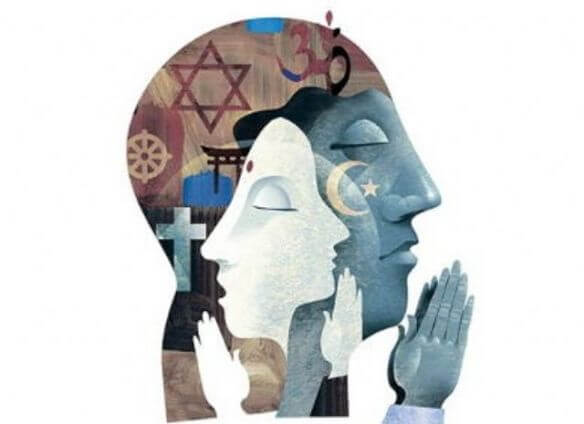
Now that we understand what “secular” means, let us look at how it emerged. Secularism arose with the cultural movement called the Enlightenment, which took place in the 18th century. In an age when individualism gained prominence, freedom of thought, belief and worship were folded into individual rights.
Secularization rests on the relationship between religion and modernity. The thesis holds that the world has become so thoroughly modern that religion’s significance and influence will no longer be what it once was.
The English reformist thinker George Jacob Holyoake was the first to use the term “secularism” as a concept (1851). By this word, Holyoake did not mean an atheist or anti-religious stance, but rather the idea that the state and the education system should operate independently of religious dogma. The 1789 French Revolution’s practice of laïcité, the First Amendment of the 1791 U.S. Constitution forbidding the establishment of religion, and the 1905 French Law of Separation of Church and State are the legal milestones that shaped the concept.
Three forces underpinned the Enlightenment: the scientific revolution (Galileo, Newton), the religious pluralism that emerged after the Reformation and Counter-Reformation, and the rise of the bourgeoisie alongside the concept of a public sphere. At their intersection, religion ceased — for the first time in modern Europe — to be “natural” and became a debatable, criticizable domain.
What Is the Difference Between Secularism and Laicism?
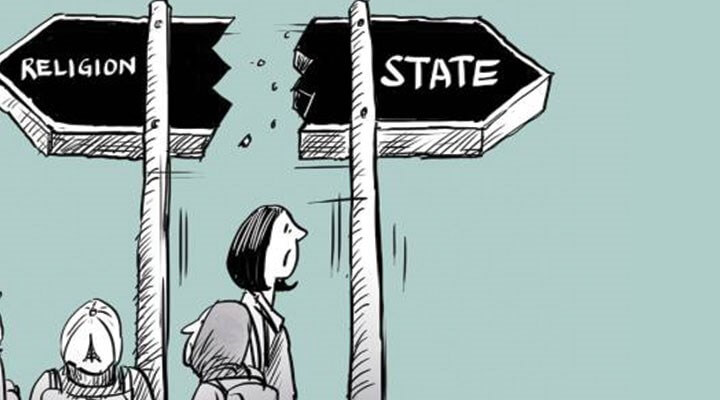
Secularization is often confused with laicism. Laicism holds that the affairs of religion and state must be conducted separately. Secularism, by contrast, carries a more individual meaning, less tied to politics. It maintains that, regardless of personal belief, one should conduct life through worldly rationality. In this sense, secularization keeps a person’s religion within their own conscience while encouraging them to acknowledge their shortcomings, meet new people, gain new experiences and contribute to a more tolerant and progressive world.
Seen through this lens — given how small the proportion of people in Turkey who entirely devote themselves to religious belief and worship, isolated from social life, actually is — one could say that almost all of the population embraces a secular way of life.
The American sociologist Howard Becker divides societies into two: sacred (unchangeable) and secular (changeable). For Becker, a sacred society does not alter its existing molds and inherited judgments. A society that wishes to change its existing forms is a secular society. Whether the whole of a society or part of it rejects change, that society is “sacred”; one that is open to or driven toward change is “secular.”
The comparison table below places the three key concepts side by side:
| Dimension | Secularism | Laicism | Atheism |
|---|---|---|---|
| Primary focus | The individual’s worldly life, public reasoning | The structure of the state, institutional order | The question of God’s existence/non-existence |
| Historical source | Enlightenment (Holyoake, 1851) | France, laïcité (1789–1905) | From ancient Greece through modern enlightenment |
| Legal framework | Constitutional guarantee, pluralism | Constitutional clause, institutional separation | Not a legal concept; individual conviction |
| Stance toward belief | Individual freedom of belief is protected | State neutrality required; individual belief free | Rejects religious belief |
| Equivalent in Turkey | Widespread life practice; not named in the constitution | Constitutional principle since 1937 (Art. 2) | Individual; limited social visibility |
| Typical question | “How decisive should religious authority be in public choices?” | “How does the state regulate religious matters?” | “Does a god really exist?” |
To summarize: secularism is a way of life and a question of public reason; laicism is a principle of institutional separation; atheism is a metaphysical position. While all three often coexist, they cannot conceptually replace one another.
The History of Secularization and Laicism in Turkey
In the late Ottoman period, the Tanzimat (1839) and Islahat (1856) edicts took the first steps toward distancing the apparatus of state from religious foundations. Under the Republic, a sharp legal-institutional break followed:
- 1924 — Abolition of the Caliphate and the Unification of Education Law, consolidating education under one authority.
- 1926 — Adoption of the Turkish Civil Code based on the Swiss Civil Code; positive law supplants religious law in family, inheritance and personal matters.
- 1928 — Removal of the clause “The religion of the state is Islam” from the Constitution; transition to the Latin alphabet.
- 1937 — Direct inclusion of laicism in Article 2 of the 1924 Constitution.
- 1982 Constitution — Laicism is among the immutable principles whose amendment cannot even be proposed (Art. 4).
This legal architecture brings Turkey close to a “French-style” strict laicism model: the state reserves certain rights of oversight over religion (via the Diyanet İşleri Başkanlığı) while guaranteeing the non-religious functioning of the public sphere. Sociologically, however, Turkey does not fit the classical European secularization thesis: religious practice and secular life often interweave in the daily routine of a single individual. In 2026 Turkey, hybrid practices such as digital piety, conditional fasting and “Ramadan secularism” are current manifestations of this intertwining.
The Post-Secular Age and the 2026 Agenda
Throughout the 20th century, many thinkers assumed religion would fade. Yet the 21st century is defined by religion’s growing public visibility, the rise of new forms of piety, and the global political weight of religious identities. The sociologist Peter L. Berger, who for years had championed the classical secularization thesis, retracted it in his 1999 essay The Desecularization of the World, conceding that modernity and religiosity may rise in tandem.
Habermas’s notion of the “post-secular society” is the philosophical counterpart of this reality: secular institutions and religious citizens may share a common public ground for deliberation without seeing one another as alien. On this view, the secular individual must learn to translate the religious citizen’s arguments, while the religious citizen must learn to share their argument through publicly accessible reasoning.
As of 2026, debates over AI ethics, biomedical limits (gene editing, cloning), and climate justice — both in Turkey and globally — have moved far beyond the classical laicism debate, reopening the question of “where does secular morality come from?” Secularity is therefore no longer merely “the line between religion and state” but the question of how plural value systems coexist and negotiate.
Secular Life Practices and Modern Identity
To understand how an individual experiences secularization in everyday life, one must look at concrete practices. Choosing secular curricula in education, treating only the civil marriage as sufficient, reducing certain religious elements in funeral rituals, taking the Gregorian calendar as default, raising children with a conscience-based rather than religion-based ethics — all of these are sociologically secular practices. According to TÜİK’s 2026 life-values surveys, the bulk of the urban middle class defines itself as “believing but not letting religious rules be decisive in daily decisions.” This is the concrete counterpart of Taylor’s “world of multiple options”: belief exists, yet non-religious modes of life are also legitimate, visible and socially acceptable.
The most important cognitive transformation secularization produces is the figure of the individual who builds personal meaning under their own responsibility. When tradition, religious authority, or community no longer single-handedly supply a framework for life, the individual must construct their own values, ethical reference points and horizon of meaning. This is at once a great freedom and the heavy responsibility modern psychology calls the “crisis of meaning.” For precisely this reason, contemporary discussions of secularism extend beyond law and politics into psychology, education, and family policy.
Frequently Asked Questions
1. Can a secular individual be religious?
Yes. Being secular does not mean being atheist. A secular individual may live their personal faith in their own conscience while insisting that public decisions be made on non-religious, reasoned grounds. Most of Turkey’s population fits this profile.
2. Are secularism and laicism the same thing?
No. Laicism speaks more to the structure of the state, secularism more to the individual’s way of life and public reasoning. A state may be laic while the society is not secularized — and vice versa.
3. Does the Turkish Constitution use the word “secular”?
No. Article 2 of the Constitution of the Republic of Turkey enshrines the principle of laicism. “Secular” is used more in academic and everyday language.
4. Why has the classical secularization thesis lost its validity?
Because the 21st century has shown that religion does not entirely retreat with modernization. Sociologists like Casanova, Berger and Taylor have demonstrated that religious practice persists in altered forms, and in some geographies has even strengthened.
5. What exactly is a “post-secular” society?
Habermas’s term denotes a model of society in which religious and secular citizens negotiate in the same public sphere while mutually recognizing each other’s legitimacy. Mutual translation and equal citizenship are central.
6. Is secularism opposed to religious symbols?
Not necessarily. Some readings (French laïcité) advocate limiting religious symbols in public space; others (the Anglo-Saxon reading) allow wide individual expression. After 2010, Turkey has shifted closer to the Anglo-Saxon reading.
Sources
- TÜBİTAK Encyclopedia, “Secularization” entry — https://ansiklopedi.tubitak.gov.tr/ansiklopedi/sekulerlesme
- Türk Dil Kurumu, Current Turkish Dictionary, entry “secularism” — https://sozluk.gov.tr
- Charles Taylor, A Secular Age, Harvard University Press, 2007.
- José Casanova, Public Religions in the Modern World, University of Chicago Press, 1994.
- Jürgen Habermas, “Notes on Post-Secular Society”, New Perspectives Quarterly, 25(4), 2008.
- Peter L. Berger (ed.), The Desecularization of the World, Eerdmans, 1999.
- Ali Bayer, Secularization and Religion, İksad Publishing, 2022 — https://iksadyayinevi.com/wp-content/uploads/2022/12/SEKULERLESME-VE-DIN.pdf
- Felsefe.gen.tr, “Secularism” — https://www.felsefe.gen.tr/sekularizm/
- Sosyologer, “What Is Secularism? The Concept in Sociology” — https://www.sosyologer.com/sekulerizm-nedir-sosyolojide-sekulerizm-kavrami/
This post is also available in: