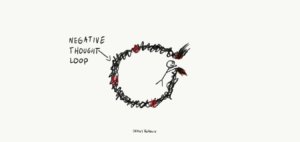

TL;DR. The number you have seen is 35,000. It has reached peer-reviewed literature: a 2025 integrative review in Frontiers in Cognition opens by stating that an average American adult makes approximately 35,000 decisions per day. We followed that citation backwards. It points to a 2020 concept analysis in the Journal of Health Psychology. That paper points to a newspaper opinion column, listed in its own reference list with no volume, no page numbers and no DOI. The chain ends there. No measurement exists at any step. A full-text search of the Europe PMC corpus returns five papers containing the phrase “35,000 decisions” and zero that report it as an original finding. The one number that was genuinely measured, 226.7 food decisions a day, came from asking 154 people to estimate their choices category by category, and the same 154 people put the figure at 14.4 when asked directly and once. In 2025, researchers at the Max Planck Institute for Human Development attributed the gap to a known measurement artifact rather than to hidden behaviour. The practical conclusion is not that decision fatigue is fake. It is that the count is fiction, and a count you cannot make is a bad thing to organise your life around. What you can count is stakes.
If you have arrived here wanting to know what the fatigue research itself supports, that is a separate question with a separate answer, and we have laid out the full evidence ledger in our companion piece on what the decision fatigue research actually shows. This article is about something narrower and stranger: where the numbers came from.
A number that cannot survive division
Start with arithmetic, before any citation work.
Assume a generous sixteen-hour waking day. Thirty-five thousand decisions across that span is 2,188 decisions per hour, or 36.5 per minute. That is one decision every 1.64 seconds, sustained, from the moment you wake until the moment you sleep, without pause for the decisions that take longer than 1.64 seconds.
The figure is not describing anything a person could plausibly report, observe or record. It only survives if “decision” is stretched to include every micro-adjustment the nervous system makes below awareness, at which point the number is not 35,000 either. It is unbounded, and therefore meaningless as a count.
That is a reason for suspicion, not a refutation. So we went looking for the source.
The citation trail
The 35,000 figure now appears in the peer-reviewed literature, which is what makes it durable. Search engines and AI systems weight academic sources heavily, and a claim that has crossed into a systematic review acquires a credibility its origins never earned. We traced the chain one link at a time.
Table 1. CEOtudent citation audit: tracing the 35,000-decisions claim to its terminal source. Each row records what the publication states and what it names as its own authority. Trail followed 3 September 2026.
| Step | Publication | What it asserts | What it cites as the source |
|---|---|---|---|
| 1 | Integrative review on the causes and effects of decision fatigue, Frontiers in Cognition, 2025 | “An average American adult makes approximately 35,000 decisions per day” | Pignatiello et al., 2020 |
| 2 | Decision fatigue: a conceptual analysis, Journal of Health Psychology, Pignatiello, Martin and Hickman, 2020 | “It is estimated that an American adult makes 35,000 decisions a day” | Sollisch, 2016 |
| 3 | Sollisch, 2016 | Listed in that reference list as a newspaper opinion column, with no volume, issue, page range or DOI | No empirical source given |
Three steps, and the trail runs out. There is no study at the end of it. There is no dataset, no sample, no method, no instrument. A peer-reviewed 2025 review opens on a factual claim whose ultimate authority is a newspaper column, and the column was never presenting original research in the first place.
This is not an accusation of misconduct against anyone in the chain. Each author cited a source that appeared to be a source. That is exactly how a citation chain launders an unmeasured number into an established fact, and it is why tracing chains is worth doing.
Auditing the corpus directly
A single trail could be an unlucky sample. So we checked the literature as a whole, using a query anyone can repeat.
Table 2. CEOtudent corpus audit: how often the number appears in peer-reviewed full text. Europe PMC full-text search across the open access corpus, run 3 September 2026. The third column reflects our reading of every hit returned.
| Search phrase | Full-text hits | Hits reporting it as an original measurement |
|---|---|---|
| “35,000 decisions” | 5 | 0 |
| “35000 decisions” | 0 | 0 |
| “226.7 food” | 0 | 0 |
Five papers in the searchable corpus contain the phrase. We read all five. One is the 2025 review above. One is the 2020 concept analysis it cites. The remaining three are a hospital order-set design paper, a general medical commentary, and a neuroimaging study of decision-making in temporal lobe epilepsy patients. In all five the number appears in an opening paragraph, as scene-setting before the actual subject begins. In none of them is it measured, tested, derived or defended.
Zero out of five. The number has citations but no evidence, which are very different things.
One of those five is worth singling out, because it corroborates the trail independently. The 2016 medical commentary does not treat the figure as a research finding at all. It says plainly that Jim Sollisch, in a column in The Wall Street Journal, estimated that the average American adult makes 35,000 decisions a day. That is an author in 2016 correctly describing the number as a newspaper columnist’s estimate. Four years later the same figure was reproduced in a peer-reviewed concept analysis with the attribution intact but the framing gone, and five years after that a systematic review restated it as an established average. The provenance was never hidden. It was simply dropped, one citation at a time.
The number that was actually measured
There is one real attempt to count daily decisions, and it is worth understanding precisely, because it is the origin of the second figure you have probably seen.
Wansink and Sobal published it in Environment and Behavior in 2007. They asked 154 people how many food and drink decisions they made in a day. The average answer was 14.4. Then they asked the same people to break it down: for each meal, snack and beverage, how often did they decide when, what, how much, where and with whom. Multiplying and summing those itemised estimates produced an average of 226.7.
The 212.3-decision gap between the two figures became the headline, interpreted as the volume of eating choices people make without noticing.
Table 3. What each figure actually rests on. Verified against the primary publications.
| Figure | Primary source | What was actually measured | Status as of September 2026 |
|---|---|---|---|
| 14.4 food decisions per day | Wansink and Sobal, Environment and Behavior, 2007, 39(1), 106-123 | Direct self-estimate, 154 participants | Not retracted |
| 226.7 food decisions per day | Same study, same 154 participants | The same self-estimates, itemised by category and then summed | Not retracted; interpretation contested |
| 212.3 “mindless” decisions per day | Derived by subtracting the first from the second | Nothing was observed; this is the gap between two ways of asking the same people the same question | Attributed to a measurement artifact, Claassen, Mata and Hertwig, Appetite, 2025, 209, 107928 |
| 35,000 decisions per day | None identified | Nothing | No primary measurement located |
In 2025, Claassen, Mata and Hertwig published a deconstruction of the 200-decisions belief in Appetite. Their argument is that the gap is produced by subadditivity: when you ask people to itemise a total category by category and then add the pieces up, the sum reliably exceeds what the same people report when asked for the total directly. The effect is well documented across domains and has nothing to do with eating. On that reading, the 212.3 figure does not measure unnoticed behaviour. It measures the difference between two question formats.
Note carefully what this is and is not. The Appetite paper is a conceptual and methodological critique, not a replication study with a new sample. It does not produce a corrected count. It argues that the concept was never operationalised well enough for a count to mean anything, and calls for better definitions and methodological pluralism instead. There is no rival number waiting to replace 226.7. That is the point.
The provenance question nobody asks
Brian Wansink, first author of the 2007 study, resigned from Cornell in 2018 following a faculty investigation that found misconduct in his research and scholarship. Given that, the obvious assumption is that the food-decisions number is simply fraudulent.
We checked, because the obvious assumption is wrong, and the way it is wrong matters.
Table 4. CEOtudent publication audit: the Wansink record as indexed in PubMed. Query run 3 September 2026 against author field “Wansink B”. Percentages are derived from the counts in this table.
| Metric | Count |
|---|---|
| Publications indexed in PubMed | 171 |
| Flagged “Retracted Publication” | 12 |
| Flagged “Published Erratum” | 12 |
| Retracted or formally corrected, combined | 24 |
| Share of indexed output retracted or corrected (derived) | 14.0 percent |
Two caveats keep this honest. First, PubMed indexes biomedical literature, so this is a partial view of a career that also published in marketing and behavioural journals; counts reported elsewhere are higher because they draw on a wider net. Second, and more importantly for our purposes: the 2007 Environment and Behavior paper is not in this set. PubMed indexes no articles from that journal for 2007 and returns no Wansink and Sobal co-authored record from that year, and the paper carries no retraction or correction flag in the Crossref registry.
So the 226.7 figure is not retracted science. It is un-retracted science whose interpretation does not hold. That distinction is the whole lesson. A number can be produced honestly, published legitimately, survive every integrity check, and still describe nothing, because the instrument that generated it was measuring the question rather than the world.
What the evidence base actually looks like
If the counts are hollow, what about the cost? Here the literature is more candid than its popularisers.
The 2020 concept analysis in the Journal of Health Psychology searched seven databases and found 17 relevant articles. Its stated conclusion was that the existing literature failed to adequately describe the consequences of decision fatigue. That is the paper that introduced the 35,000 figure to the academic record, and in the same breath it reported that the downstream costs were not documented.
The 2025 integrative review is the most systematic recent attempt. Its screening funnel is instructive.
Table 5. CEOtudent derived analysis of the 2025 integrative review’s evidence base. Counts as reported in the review; shares derived.
| Stage or category | Count | Share |
|---|---|---|
| Records identified in database search | 1,024 | – |
| Records after duplicate removal | 1,020 | – |
| Full-text articles assessed for eligibility | 27 | 2.6 percent of 1,020 |
| Excluded after quality appraisal | 4 | – |
| Studies included in the final review | 23 | 2.3 percent of 1,020 |
| Included studies set in healthcare | 13 | 56.5 percent of 23 |
| Included studies in financial or economic analysis | 5 | 21.7 percent of 23 |
| Included studies in the judiciary | 2 | 8.7 percent of 23 |
| Academic librarianship, parenting, multiple organisations | 1 each | 13.0 percent combined |
Two things fall out of this table that the review does not state directly. The entire cross-domain evidence base for decision fatigue, after systematic screening, is 23 studies. And more than half of them were conducted in healthcare settings, on clinicians making sequenced clinical judgements under caseload pressure, which is a specific and unusually well-instrumented environment.
That is a reasonable body of evidence about clinicians. It is a thin basis for a universal claim about how your Tuesday works. The generalisation from 13 hospital studies to 35,000 daily decisions in every adult life is doing an enormous amount of unearned work.
The reframe: count stakes, not decisions
Here is where the CEO and the student have to divide the labour.
The student instinct, when handed a number like 35,000, is to optimise against it: reduce choices, wear the same shirt, automate breakfast, protect the finite budget. That instinct is not wrong in spirit, but it is aimed at a quantity nobody can measure, and it quietly assumes that all decisions draw on the same account. The audit above gives no support for either premise.
The CEO instinct is different. A CEO does not ask how many decisions were made this quarter. That number exists and is entirely useless. A CEO asks which decisions were expensive, and whether the expensive ones got the attention they deserved.
That is a question you can actually answer about yourself, because the denominator is small.
The CEOtudent Stakes Ledger. A framework for replacing an uncountable metric with a countable one. Sort your recurring decisions into three columns, and note that the columns get radically smaller from left to right.
| Column | Definition | What it costs when handled badly | The correct move |
|---|---|---|---|
| Repeats | Decisions you make more than once a week, with the same inputs and the same acceptable answer | Almost nothing individually; the cost is the attention residue | Convert to a standing rule, once. Stop re-deciding. |
| Reversible | One-off decisions you could undo within a week at modest cost | Delay costs more than error | Decide quickly and move. Speed is the optimisation. |
| Irreversible | Decisions that are expensive or impossible to unwind: commitments, exits, public positions, money you cannot get back | Everything | Schedule them deliberately, on purpose, when rested. Never let them arrive by default. |
The exercise is to write your own third column for the past month. Most people find it is short enough to fit on one hand, and that at least one entry on it was made in a corridor, on a phone, between two things that did not matter.
Two adjacent methods do the operational work this framework only points at. Sorting by reversibility is the same test that determines which choices can be handed to a machine at all, which we set out in delegation boundaries. And the only way to find out whether your third-column decisions are actually going well is to write them down before you know the outcome, which is the protocol in our decision journal template. Neither requires a count of anything.
That is the actual finding worth acting on, and notice that it does not require knowing whether you made 35,000 decisions or 200 or 14. The count was never the variable. It was never even a number.
What to do with any statistic shaped like this one
The 35,000 claim has a recognisable shape, and once you can see the shape you will find it everywhere in the productivity and self-improvement literature. Three questions dismantle most of them.
Ask what was measured, not what was concluded. In the food-decisions case, what was measured was people’s estimates of their own estimates. No eating was observed.
Ask whether the number could survive division. Convert to a per-hour or per-minute rate and see whether a human being could plausibly do that. One decision every 1.64 seconds fails immediately. This is inversion applied to statistics: instead of asking whether the claim is true, ask what would have to be true for it to hold, and check whether that is survivable.
Ask where the citation ends. Follow it back until you reach either a dataset or a dead end. Both outcomes are informative, and in our experience the trail is usually shorter than expected.
The CEO and the student in this
The student in you should be glad the number is wrong. It was a bad number to carry: it framed ordinary daily life as a war of attrition against an enemy too large to fight, which is a reliable route to fatalism dressed as self-knowledge.
The CEO in you should notice something more useful. This claim travelled from an opinion column into a systematic review in under a decade, gathering authority at every hop, without anyone in the chain acting in bad faith. That is not a story about one statistic. It is the default failure mode of an information environment where citation counts as verification, and it is accelerating now that AI systems synthesise confidently from whatever the corpus contains.
The skill that protects you is not scepticism as an attitude. It is the specific, boring, ten-minute habit of following one claim back to its source before you build anything on it. We did it once here. It cost an afternoon and it overturned a number that has organised a great deal of advice. That habit is only available to you if you have not already committed, which is the practical case for resisting the pressure to decide immediately.
Learn like a student: check the primary source, and accept the answer when it is “nobody knows.” Lead like a CEO: stop managing a metric you cannot measure, and put your scarce deliberate attention on the small number of decisions that are genuinely expensive.
FAQ
So how many decisions do we actually make in a day?
Nobody knows, and the honest answer is that the question is not well formed. Before you can count decisions you need a definition that says where one decision stops and the next begins, and whether unconscious adjustments count. The 2025 Appetite paper’s central argument is precisely that this definitional work was never done, which is why counts produced so far do not mean much. There is no corrected figure to offer in place of 35,000.
Is the 35,000 number simply made up?
There is no evidence anyone fabricated it deliberately. What the trail shows is that it entered circulation through a newspaper column, was cited by an academic paper as if it were a research finding, and was then cited onward by a systematic review as if the academic paper had established it. That is a sourcing failure, not a fraud.
Is decision fatigue itself fake, then?
No, and this article does not argue that. The counting claims are unsupported; that is a separate question from whether sequential decision-making degrades judgement. There is real evidence on that, some of it strong and some of it that has failed replication badly. We have set out which claims hold and which collapsed in our companion piece on what the decision fatigue research actually shows.
Does the Wansink misconduct finding mean the food-decisions study is discredited?
Not in the formal sense. The 2007 paper carries no retraction or correction notice, and it does not appear among the retracted publications indexed in PubMed. The problem with the 226.7 figure is methodological rather than ethical: asking people to itemise a total and then summing the items reliably inflates the result, an effect that has nothing to do with that study’s integrity.
What should I do differently on Monday morning?
Write down every decision from the past month that you could not easily undo. That list is your real workload. Then check whether any of them were made in transit, tired, or between other commitments, and move the next one on the list to a time you have actually protected.
Why does this matter more now than it did five years ago?
Because AI systems are increasingly the layer between a question and an answer, and they synthesise from the published corpus. A claim that has crossed into peer-reviewed literature is disproportionately likely to be repeated as established fact, regardless of whether anything underneath it was ever measured. Provenance auditing used to be a specialist academic habit. It is becoming a general literacy.
Sources
Claassen, M. A., Mata, J., and Hertwig, R. The (mis-)measurement of food decisions. Appetite, 2025, volume 209, article 107928.
Wansink, B., and Sobal, J. Mindless eating: the 200 daily food decisions we overlook. Environment and Behavior, 2007, volume 39, issue 1, pages 106-123.
Pignatiello, G. A., Martin, R. J., and Hickman, R. L. Decision fatigue: a conceptual analysis. Journal of Health Psychology, 2020.
An integrative review on unveiling the causes and effects of decision fatigue to develop a multi-domain conceptual framework. Frontiers in Cognition, 2025.
Hagger, M. S., and colleagues. A multilab preregistered replication of the ego-depletion effect. Perspectives on Psychological Science, 2016, volume 11, pages 546-573.
Max Planck Institute for Human Development, press release on the measurement of daily food decisions, 2026.
Europe PMC full-text search corpus, European Molecular Biology Laboratory, European Bioinformatics Institute. Queries run 3 September 2026.
PubMed, National Library of Medicine, National Institutes of Health. Author and publication-type queries run 3 September 2026.
Crossref metadata registry. Record queries run 3 September 2026.
This content was compiled with the support of AI following in-depth research, then written and prepared for publication by the CEOtudent editorial team.
This post is also available in: