
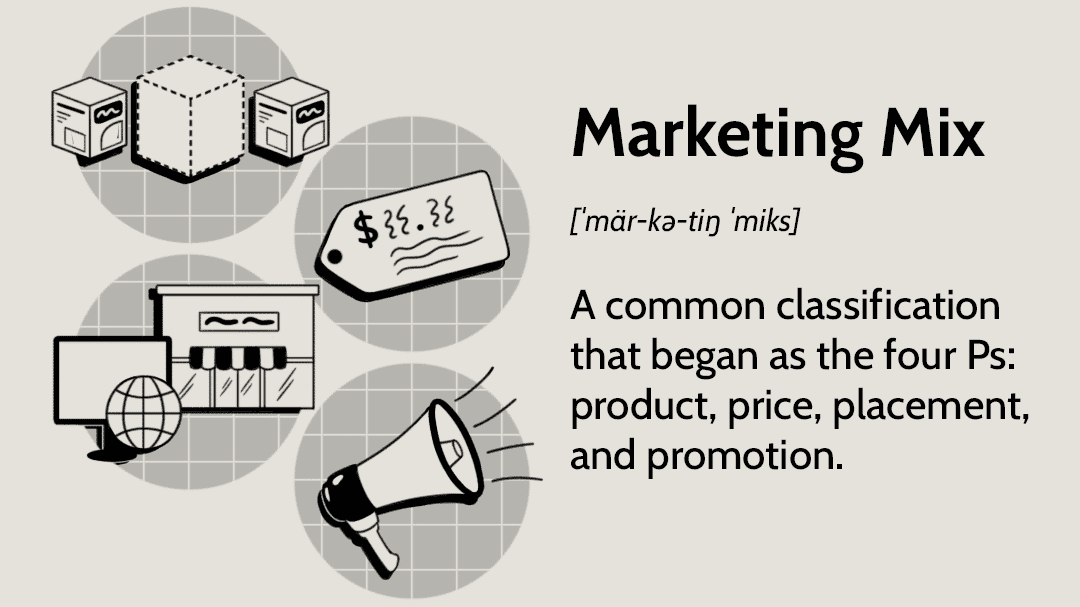
Short answer: The marketing mix is how a company manages its four controllable variables together – Product, Price, Place, Promotion – to achieve the positioning it wants in a target market. The concept was introduced by Neil Borden (1953), turned into the 4P framework by E. Jerome McCarthy (1960), and popularized by Philip Kotler. For service marketing the model grew into 7P (4P + People, Process, Physical Evidence – Booms & Bitner 1981), and from the consumer’s perspective into 4C (Customer, Cost, Convenience, Communication – Lauterborn 1990). In the digital era the 4P have been reshaped by personalization, dynamic pricing, multi-channel distribution and content marketing.
The marketing mix is a company’s set of control levers in the market. It is the synthesis of the four (or seven) variables that decide which product you sell, to whom, at what price, through which channel, and with which message. This guide covers the historical roots of the model, its 4P/7P/4C components, how it is applied in digital marketing, and concrete worked examples.
The Marketing Mix Concept: Historical Development
1953 – Neil Borden and the “Marketing Mix”
Harvard Business School professor Neil Borden introduced the concept in his 1953 article “The Concept of the Marketing Mix”, using the metaphor of a cook blending the ingredients of a recipe. Borden’s original list contained 12 elements: product planning, pricing, branding, distribution, personal selling, advertising, promotions, packaging, display, physical handling, fact-finding and analysis, and servicing.
1960 – E. Jerome McCarthy and the 4P
E. Jerome McCarthy grouped Borden’s 12 elements under four core categories: Product, Price, Place, Promotion. The 4P model, which entered the literature through McCarthy’s Basic Marketing: A Managerial Approach (1960), became the core framework of modern marketing.
1967 – Philip Kotler and Marketing Management
Philip Kotler’s Marketing Management: Analysis, Planning, and Control (1967) made the 4P model the standard concept of management academia. For Kotler, the 4P are the implementation tool of the strategic segmentation-targeting-positioning (STP) process.
1981 – Booms & Bitner and the 7P (Service Marketing)
Bernard Booms and Mary Bitner found the 4P insufficient for the service sector and added three more components: People, Process, Physical Evidence. The “cannot be shelved like a product” nature of service marketing made these three extra variables necessary.
1990 – Robert Lauterborn and the 4C
Robert Lauterborn criticized the 4P as company-centric and proposed the consumer-centric 4C model: Customer Needs, Cost, Convenience, Communication.
The 4P in Detail
1) Product
The good or service offered to the market. Decision areas:
- Core features (quality, performance)
- Design and aesthetics (visual identity, user experience)
- Brand (name, logo, brand perception)
- Packaging (protecting the product + communication)
- Variety (variants, sizes)
- Warranty and service (after-sales support)
- Life cycle (introduction to growth to maturity to decline)
Example: Nike positions its product line as innovation-led athletic footwear and apparel, layering performance technology lines on top of everyday wear and using dedicated sustainability initiatives to open new segments. Nike is a globally recognized brand, so its product strategy is widely studied as a benchmark.
2) Price
The amount the consumer is willing to pay for the product. Decision areas:
- Cost-based pricing (cost-plus)
- Competition-based pricing
- Value-based pricing
- Psychological pricing ($99 vs $100)
- Artificial scarcity (premium positioning – the Supreme example)
- Dynamic pricing (time, demand, user based – Uber, Booking.com)
- Discount and promotion policies
For Kotler, the basic question of price is this: “Where does the price the seller wants to receive intersect with the point the buyer is willing to pay?”
3) Place
The channel through which the product reaches the customer. Modern distribution is considered across three dimensions:
- Channel type: Direct (from producer to consumer), indirect (wholesaler + retailer), hybrid
- Coverage intensity: Intensive (Coca-Cola – in every corner shop), selective (luxury brands – limited stores), exclusive (Rolex – authorized dealers only)
- Digital + physical (omnichannel): Integration of e-commerce + store + mobile app + social commerce
Example: A global brand like Nike integrates its own stores, nike.com, the Nike app, and wholesale plus marketplace presence into an omnichannel distribution model, so a customer can discover, try and buy across both physical and digital touchpoints.
4) Promotion
The whole set of communication activities done so that the product is known and preferred by consumers. Five core tools:
- Advertising (TV, digital, OOH)
- Public relations (PR) (press releases, events)
- Sales promotion (coupons, discounts, contests)
- Direct marketing (email, SMS)
- Personal selling (field sales teams)
In the modern era, content marketing, influencer marketing, programmatic advertising, SEO, SEM have been added to these tools.
Example: Nike’s long-running “Just Do It” brand campaigns are a textbook case of multi-channel promotion: athlete endorsements + TV and digital advertising + influencer collaborations + social media activation working together around a single brand message.
4P to 7P: Expansion in Service Marketing
Service marketing (banks, hospitals, hotels, consulting) is intangible + simultaneous + people-dependent, so the 4P fall short. Booms & Bitner (1981) add three more variables:
5) People
The employees and team quality that deliver the service. For a bank the teller, for a restaurant the server, for a hotel the receptionist directly shape the customer experience.
6) Process
How the service is delivered, step by step. In a hospital the appointment to admission to examination to billing flow; in a restaurant the greeting to order to service to payment flow.
7) Physical Evidence
The tangible traces such as the venue, uniforms, decor, brochures where the service is delivered. Because service is intangible, the customer infers quality from physical evidence.
4P to 4C: The Consumer’s Perspective
Robert Lauterborn (1990) reframed the 4P in a consumer-centric way:
| 4P (Company view) | 4C (Consumer view) |
|---|---|
| Product | Customer Needs |
| Price | Cost (total cost – money + time + effort) |
| Place | Convenience (where and how it can be reached) |
| Promotion | Communication (two-way dialogue) |
The philosophy of 4C: “Instead of producing a product and looking at what we sell, understand what the customer actually needs.”
The Marketing Mix in the Digital Era (2026)
| 4P Component | Classic Marketing | Digital Era (2026) |
|---|---|---|
| Product | One-size-fits-all product | Personalization (AI-driven recommendation systems, modular products) |
| Price | Fixed price | Dynamic pricing (algorithmic, real time) |
| Place | Store + distributor | Omnichannel (web, mobile, social commerce, marketplaces) |
| Promotion | TV/radio/print | Content + influencer + programmatic + SEO + AI chatbot |
Leading Techniques in the Digital Marketing Mix
- CDP (Customer Data Platform): Unifying all touchpoints for a single customer view
- AI Personalization: ChatGPT/Claude-based personalized recommendations and content
- Programmatic Advertising: Real-time automated ad buying
- Marketing Automation: Automated campaigns through HubSpot, Mailchimp, ActiveCampaign
- Content Marketing + SEO: Producing content for long-term organic traffic
- Influencer Marketing: Reaching niche audiences with micro-influencers (10K-100K)
Integrating the 4P with the AIDA Model
The AIDA model, developed by E. St. Elmo Lewis (1898), describes the consumer’s buying journey in four steps: Attention to Interest to Desire to Action. AIDA tells you how to communicate within the Promotion dimension of the 4P:
| AIDA Step | Promotion Technique |
|---|---|
| Attention | Outdoor, social media discovery ads |
| Interest | Blog posts, video content |
| Desire | User reviews, case studies, free trials |
| Action | “Buy now” button, discount coupon, limited time offer |
Modern derivatives: AISAS (Attention-Interest-Search-Action-Share – Dentsu, 2004), STDC (See-Think-Do-Care – Avinash Kaushik, Google).
A Full 4P Example: Nike
| Component | Nike Strategy |
|---|---|
| Product | Athletic footwear and apparel, performance innovation lines layered on everyday wear, plus dedicated sustainability initiatives |
| Price | Premium positioning with a tiered range, from accessible lines to higher-priced flagship and signature products |
| Place | Own retail stores, nike.com, the Nike mobile app, plus wholesale and marketplace presence (omnichannel) |
| Promotion | Athlete endorsements, “Just Do It” brand campaigns, influencer collaborations and digital activation |
Takeaway: Nike is a globally recognized, publicly traded apparel brand listed on the NYSE, and it is one of the most widely studied examples of disciplined 4P management – each of the four levers reinforcing a single, consistent brand position. (For exact financial figures, refer to the company’s current publicly available financial reports.)
Frequently Asked Questions About the Marketing Mix
1) Is the 4P model still valid?
Yes – but not sufficient on its own. Modern marketing combines the 4P with consumer data (4C), the service dimension (7P), and digital channel integration. The 4P is the core logic, the others are extensions.
2) Which model should I use?
| Sector | Recommended Model |
|---|---|
| Physical product sales | 4P |
| Service (bank, hotel, consulting) | 7P |
| Consumer-centric approach | 4C |
| Digital product / SaaS | 4P + AARRR (Acquisition, Activation, Retention, Referral, Revenue) |
| Omnichannel | 4P + STDC (See-Think-Do-Care) |
3) What is the difference between the marketing mix and marketing strategy?
Marketing strategy answers the question “in which market, in which position will we compete?” (STP – Segmentation, Targeting, Positioning). The marketing mix is the implementation tool of that strategy – making concrete tactical decisions through the 4P.
4) What is Place (distribution) in digital marketing?
In a digital environment, Place is the digital channel where the customer meets the product: website, mobile app, social media, marketplaces, email. An omnichannel strategy is the seamless combination of physical + digital channels.
5) Are Promotion and advertising the same thing?
No. Advertising is one sub-component of Promotion. Promotion also covers PR, sales promotion, personal selling, and direct marketing.
6) How do you build a marketing mix? Step by step
- Market research (surveys, in-depth interviews, data analysis)
- STP: Divide the market into segments to choose the target audience to write your positioning statement
- 4P decisions: Product features, price, channel, message
- Budget plan
- Execution + measurement + revision
7) Examples of 4P + digital marketing metrics
| Component | Metric |
|---|---|
| Product | NPS (Net Promoter Score), CSAT, product usage depth |
| Price | Conversion rate, AOV (Average Order Value), price elasticity |
| Place | Channel share (sales share per channel), CAC by channel |
| Promotion | CTR (Click-through rate), CAC, ROAS (Return on Ad Spend) |
The CEO+Student Lens: Manage Yourself Like a “Product” (2026)
The marketing mix is not only for companies. In an AI era where a single person can run an entire business (the solopreneur, the company of one) and where a personal brand converts directly into career capital, you can apply the same 4P framework to yourself. The logic does not change: a CEO positions the value they offer like a managed product; a student keeps re-testing and improving that product. Combine the two and you start to see your own career as a marketing mix.
The table below is an original CEOtudent framework that carries the classic 4P into the individual / solo-operator perspective. This is not a statistic; it is a thinking tool for evaluating yourself.
The Personal Marketing Mix: Apply the 4P to Yourself (CEOtudent framework, 2026)
| 4P Component | Classic meaning for a company | For you / a solo operator (2026) |
|---|---|---|
| Product | The good or service sold | Your skill stack and the problem you solve; the “product” is your expertise and the concrete output you deliver |
| Price | List price, pricing strategy | Your rate or salary expectation, your project or hourly price; how you position your value |
| Place | Store, channel, shelf | The channels where you are visible: professional profile, portfolio, open work, newsletter, network |
| Promotion | Advertising, PR, campaigns | Your personal brand: consistent content, case studies, reputation and word of mouth |
CEO move: Do not leave these four levers to chance; manage them deliberately, like a company’s marketing budget. Which P is your weakest? For most talented people the answer is Place and Promotion: the product (the skill) is good, but because nobody sees it, it cannot be priced. Think like a CEO and invest in visibility up to the level of your weakest link.
Student move: Your product (your skill) is never “finished.” In the AI era, the fastest thing to become obsolete is a narrow, single specialization; so, like a student, keep testing a new P (a new channel, a new skill layer). The marketing mix is not a static recipe but a living system that you review every quarter.
Conclusion: The Marketing Mix Is Not a “Recipe” but a “Way of Thinking”
The 4P model, a framework that has now passed 65 years since 1960, remains a transferable analysis tool. But the way it is used in the digital era is completely different from the classic physical-product economy. Personalization, real-time data, multi-channel distribution and content marketing are reshaping every component of the 4P today.
First step: Clarify your brand’s STP (segmentation-targeting-positioning). Second step: Choose 4P, 7P or 4C depending on your sector. Third step: Set 2-3 measurable goals for each component. Fourth step: Measure and revise on a 90-day cycle.
Our suggestion: Do not use the 4P only as an internal decision tool. Run the same framework on your competitors to do a competitive analysis. This exercise reveals your strategic blind spots.
Sources
- Borden, Neil H. “The Concept of the Marketing Mix”. Journal of Advertising Research, 1964 (original 1953).
- McCarthy, E. Jerome. Basic Marketing: A Managerial Approach. Richard D. Irwin, 1960.
- Kotler, Philip & Keller, Kevin Lane. Marketing Management. 16th Edition, Pearson, 2022.
- Booms, Bernard H. & Bitner, Mary J. “Marketing Strategies and Organization Structures for Service Firms”. 1981.
- Lauterborn, Robert. “New Marketing Litany; Four P’s Passe; C-Words Take Over”. Advertising Age, 1990.
This content was compiled with the support of AI following in-depth research, then written and prepared for publication by the CEOtudent editorial team.
This post is also available in:













)
&description=&image=https://ceotudent.com/wp-content/uploads/2017/03/TermDefinitions_Marketingmix_finalv1-22f83dc6a6914981ad23e574f9491f2c-1024x576.png)