TL;DR: Two old research findings and one new tool now combine into the cheapest learning advantage in history. Finding one: Josh Kaufman argued in The First 20 Hours that the curve from incompetent to reasonably skilled is steep, and roughly 20 hours of focused, deliberate practice is enough to clear it for most skills. Finding two: in 1984 Benjamin Bloom documented the “2 sigma” effect, where students given one-to-one tutoring plus mastery learning scored about two standard deviations above conventionally taught peers, better than roughly 98% of them; the catch was that human tutoring does not scale. The new tool closes that gap: a well-prompted AI can now act as a patient, always-available, one-to-one tutor, and a Harvard randomized controlled trial of 194 physics students found that a step-by-step AI tutor produced over twice the learning in less time than an active-learning class. This article gives you a repeatable eight-step 20-Hour AI Tutor Protocol, an original comparison of the five AI tutor modes, and an illustrative budget for the 20 hours. Pick the skill like a CEO; do the reps like a student.
There is a number that has scared people out of learning new things for over a decade: ten thousand hours. It came from research on world-class experts, got popularized into a slogan, and quietly convinced a lot of capable adults that picking up a new skill in their thirties or forties was hopeless. If mastery takes ten thousand hours, why even start.
The slogan was answering the wrong question. Almost nobody needs to be world-class. You need to be good enough to be useful, to make the thing, to hold the conversation, to ship the first version. And the curve to good enough looks nothing like the curve to elite. The first stretch is steep: a small amount of focused practice buys a large jump in capability, and then the curve flattens into the long, punishing grind that only matters if you are chasing the top. Josh Kaufman put a number on that first steep stretch in his book The First 20 Hours: about 20 hours of deliberate, well-structured practice is usually enough to go from knowing nothing to being noticeably competent.
For most of history the bottleneck on those 20 hours was not the hours. It was structure. The fastest way to learn is one-to-one tutoring, and almost nobody could afford a private tutor for every skill they were curious about. In 2026 that constraint is gone. This is a guide to using it.
Why a tutor beats a course: the 2 sigma finding
In 1984 the educational psychologist Benjamin Bloom published a paper with a deliberately provocative title: “The 2 Sigma Problem.” Drawing on controlled studies by his graduate students, he compared three ways of teaching the same material: a conventional classroom of about thirty students, mastery learning in a group, and one-to-one tutoring combined with mastery learning. The tutored students performed, on average, two standard deviations better than the conventional classroom. In plain terms, the average tutored student outscored about 98% of the students taught in a normal class.
That is an enormous effect, and Bloom knew it. The reason he called it a “problem” is that one-to-one tutoring does not scale. You cannot give every student a personal tutor, so the research challenge he posed was to find a group method that could match tutoring. For forty years, nobody really cracked it.
Why does one-to-one tutoring work so well? Strip away the mystique and it comes down to four mechanics a classroom cannot deliver at scale:
- It adapts to you in real time. The tutor sees exactly where you are confused and changes the next sentence accordingly. A lecture cannot.
- It closes the feedback loop instantly. You try, you are wrong, you find out why within seconds, not a week later on a graded assignment.
- It enforces mastery before moving on. A good tutor does not let you advance past a gap; a syllabus marches forward whether you understood module three or not.
- It removes the social cost of not knowing. You will ask a tutor the “dumb” question you would never raise in a room of thirty people, and that question is usually the one blocking you.
Hold those four mechanics in mind, because they are exactly what a well-prompted AI can now reproduce.
The new fact: AI can play the tutor, and the early evidence is strong
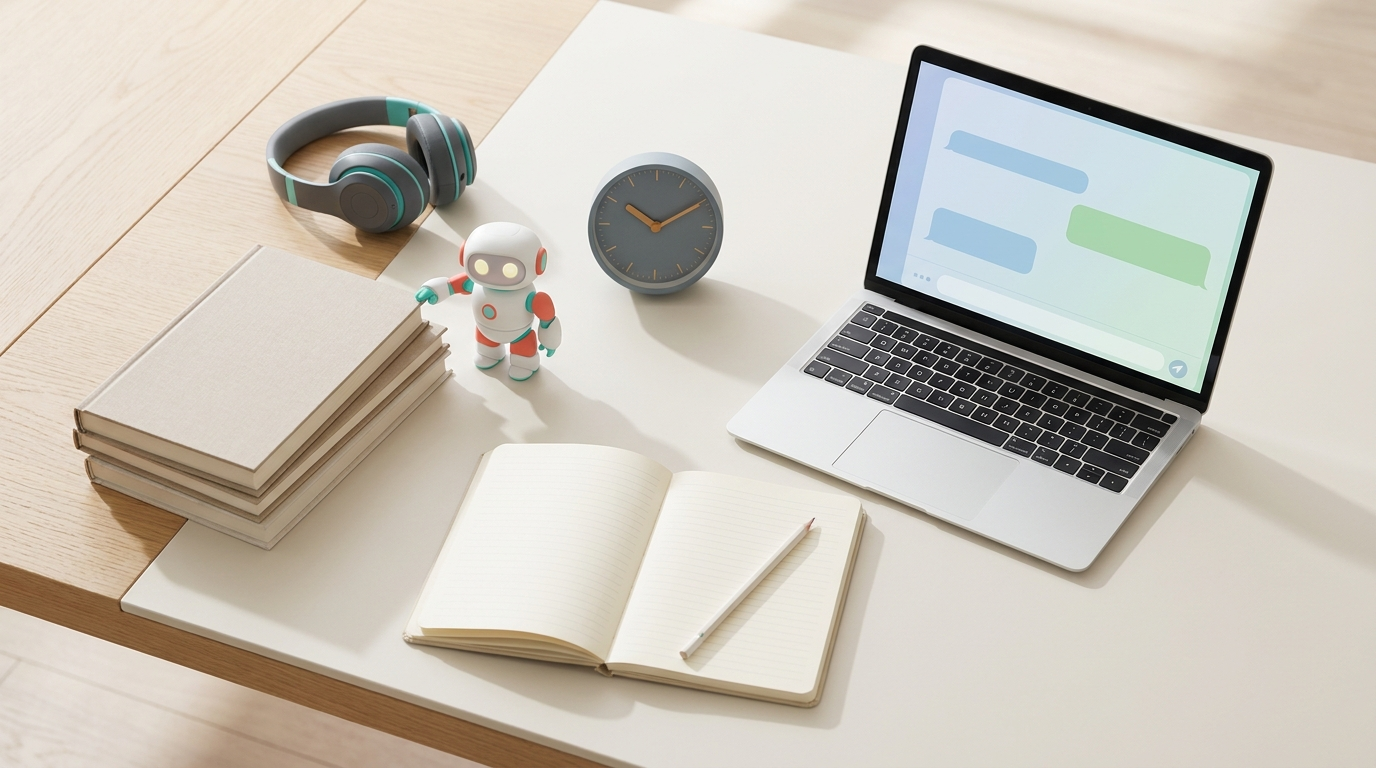
The reason this matters in 2026 and not 2019 is that large language models are good enough to do the adaptive, instant-feedback, judgment-light parts of tutoring, at near-zero marginal cost and with infinite patience. You can ask the same question five times. You can be wrong without embarrassment. You can study at 2 a.m.
The early evidence is more than anecdotal. In a randomized controlled trial run in a large Harvard undergraduate physics course (194 students, conducted in fall 2023 and later published in a peer-reviewed journal), researchers compared an AI tutor against a well-run active-learning class covering identical material. Students who learned from the AI tutor learned more than twice as much, in less time, and reported feeling more engaged. The design detail that matters most for you is how the tutor was built: it was instructed to reveal only one step at a time, to never dump the full solution, and to push the student to attempt the next step first. In other words, the gains did not come from the AI doing the work. They came from it refusing to.
That is the single most important lesson for anyone trying this at home. A default chatbot will happily hand you the finished answer, which feels like progress and produces almost no learning. The tutoring effect only appears when you force the AI into a Socratic, one-step-at-a-time posture. Most of the protocol below is about doing exactly that.
The 20-Hour AI Tutor Protocol
This is an original eight-step protocol for spending roughly 20 focused hours moving from zero to useful on almost any learnable skill, using an AI as your tutor. It is a structure, not a guarantee; outcomes depend on the skill, your starting point, and the quality of your practice. Treat it as a checklist you run top to bottom.
Step 1 – Define the target in one concrete sentence. Not “learn Spanish” but “hold a five-minute conversation ordering food and asking directions.” Not “learn Python” but “write a script that reads a spreadsheet and emails me a summary.” A vague target cannot be tutored because neither you nor the AI knows when you are done. Write the sentence down. This is the CEO decision: what specifically are we buying with these 20 hours.
Step 2 – Have the AI deconstruct the skill. Paste your target sentence and ask the AI to break the skill into the smallest set of sub-skills that actually move the needle, ranked by leverage. Most skills have a handful of high-frequency components that produce the majority of real-world capability. You are looking for those, not a complete curriculum. Ask it to be explicit about what to deliberately ignore for now.
Step 3 – Set the tutor’s rules of engagement. This is the prompt that converts a chatbot into a tutor. Tell it, in your own words: act as my one-to-one tutor; teach one concept at a time; after each concept give me a single problem to attempt; wait for my answer; if I am wrong, do not give me the solution, give me a hint and let me try again; only advance when I have demonstrated I understand. Save this prompt. You will reuse it every session.
Step 4 – Front-load the 20% that unlocks the most. Spend the first few hours only on the highest-leverage sub-skills from step 2. Resist the urge to be comprehensive. The goal of the early hours is to get to your first crude, working attempt as fast as possible, because nothing accelerates learning like doing the real thing badly.
Step 5 – Practice in tight try-fail-correct loops. This is the core of the 20 hours and where the 2 sigma mechanics live. Attempt, be wrong, get an immediate targeted hint, try again. Keep the loops short. If the AI ever just gives you the answer, stop and remind it of the step 3 rules. The feeling you want is mild, constant struggle, not comfortable reading.
Step 6 – Teach it back to expose your gaps. At the end of each session, explain what you just learned back to the AI as if teaching a beginner, and ask it to find the holes, the things you stated vaguely or got subtly wrong. The act of explaining surfaces gaps that re-reading hides. This is the cheapest diagnostic you have.
Step 7 – Schedule spaced recall, not rereading. Ask the AI to quiz you on prior sessions at the start of each new one, pulling from material a few sessions back, not just last time. Retrieval under mild difficulty is what moves knowledge into durable memory; passively rereading your notes mostly produces the illusion of knowing.
Step 8 – Ship one real artifact before hour 20. End with something that exists in the world: the conversation held, the script that runs, the page written, the dish cooked. A finished artifact is the only honest test of whether the 20 hours worked, and it is what converts “I studied” into “I can.” This is the CEO close: did the capital produce an asset, yes or no.
The five AI tutor modes, and when to use each
A common mistake is to use the AI in one register, usually “explain this to me,” for the entire 20 hours. Different phases of learning need different modes. The table below is an original synthesis of the five modes worth knowing, what each is for, the prompt posture that triggers it, and the failure mode to watch for. Match the mode to the phase you are in.
| Mode | Best for | Prompt posture | Failure mode to avoid |
|---|---|---|---|
| Socratic step-by-step | Core skill-building, the heart of practice | “One step at a time, hint do not solve, wait for me” | AI dumps the full answer; you feel progress, learn little |
| Explain-back / teach-the-tutor | Finding hidden gaps after a session | “I will explain it to you; find what I got vague or wrong” | You stay in the comfortable role of listener |
| Drill generator | Building speed and automaticity on basics | “Generate 10 short problems at my level; do not explain yet” | Drilling things already easy; no rising difficulty |
| Project critic | Improving a real artifact you made | “Here is my attempt; critique it like a demanding mentor” | Asking it to rewrite instead of critique; you skip the learning |
| Spaced-recall quizmaster | Locking in durable memory across sessions | “Quiz me on sessions one to three before we start today” | Only ever testing the most recent material |
Notice that only one of the five modes, the Socratic step-by-step, is where the heavy learning happens, and it is the one the AI resists by default. The other four are scaffolding around it. A good 20 hours cycles through all five rather than living in any single one.
How to spend the 20 hours: an illustrative budget
The 20 hours are not interchangeable. Below is an illustrative allocation, a CEOtudent design choice for how a typical zero-to-useful run tends to break down, not a measured optimum. Treat it as a starting default to adjust by skill: motor skills (an instrument, a sport) lean heavier on drilling, while conceptual skills (a language’s grammar, a coding pattern) lean heavier on Socratic loops and recall.
| Phase | Roughly how many hours | Primary mode | What “done” looks like |
|---|---|---|---|
| Target + deconstruction (steps 1-2) | 1 to 2 | Planning with AI | A one-sentence target and a ranked sub-skill list |
| Front-loading the vital 20% (step 4) | 3 to 4 | Socratic step-by-step | A first crude working attempt exists |
| Core try-fail-correct practice (step 5) | 9 to 11 | Socratic + drill | You can do the common cases without prompting help |
| Gap-hunting + spaced recall (steps 6-7) | 2 to 3 | Explain-back + quizmaster | Your known gaps are written down and shrinking |
| Shipping the artifact (step 8) | 1 to 2 | Project critic | One real, finished thing in the world |
The numbers are deliberately ranges, and they sum to about twenty. The point is not the precision; it is the shape. Most self-taught learners over-invest in the first two rows, the comfortable planning and front-loading, and under-invest in the third, the uncomfortable core practice where the actual skill is built. If your hours are not mostly in row three, you are studying, not learning.
The CEO move: treat the 20 hours like a capital allocation
The reason to frame this as CEO plus student is that the two halves fail in different ways, and most people are only good at one.
The student in you is the one who does the reps: the patient, slightly uncomfortable try-fail-correct grind of step 5. That half is necessary and most people, once they start, can do it. The half people skip is the CEO.
A CEO does not learn skills at random. They decide, before spending any capital, whether this skill is worth 20 hours at all, given everything else those hours could buy. So before you run the protocol, ask three CEO questions. First, leverage: will being merely competent at this actually change something in my work or life, or am I learning it because it is fashionable. Second, durability: in a world where the Future of Jobs research projects that a large share of core skills will shift by 2030, is this a skill that compounds or one that the next tool release will absorb. Third, fit: does this combine with what I already do, multiplying it, or is it an isolated hobby. Twenty hours is cheap, but your attention is not, and the most common learning mistake is not quitting too early. It is spending real hours becoming competent at something that never deserved the investment.
That is the whole discipline in one line. Choose the skill like a CEO allocating scarce capital toward a thesis, then learn it like a student who only has to get good, not be the best. The 20 hours have never been more affordable. What still costs something is deciding which 20 hours are worth spending.
Frequently asked questions
Is “20 hours” a scientific law or a rule of thumb?
A rule of thumb, and it should be treated as one. It comes from Josh Kaufman’s argument in The First 20 Hours that the curve from incompetent to reasonably skilled is steep and clears in roughly that range for many skills. It is not a measured constant, and it is explicitly about reaching useful, not expert; the path to elite performance is the much longer, flatter part of the curve that the 20 hours does not touch. Use it as a planning anchor, not a promise.
Does the Harvard study mean AI tutors are better than human teachers?
No, and the researchers would not claim that. The randomized trial found that a specifically designed step-by-step AI tutor outperformed an active-learning class on two physics topics in terms of learning per unit time. It is one strong study in one subject, the AI was carefully engineered to teach rather than to answer, and it does not say AI should replace teachers. What it does establish is that a well-built tutoring posture, which you can approximate with good prompting, produces real, measurable learning gains. The design lesson, reveal one step at a time, matters more than the headline.
Why not just ask the AI for the answer? It is faster.
Because faster answers and faster learning are opposites here. The Harvard tutor produced its gains precisely because it refused to hand over solutions and forced students to attempt each step first. If you let the AI do the work, you get the artifact without the skill, and next time you will need the AI again. The mild struggle of being given a hint instead of an answer is not a bug in the method; it is the method.
What skills is this protocol bad for?
Anything where the binding constraint is not knowledge but supervised physical safety or licensed judgment, for example surgery, flying a plane, or electrical work, where being “reasonably good in 20 hours” is dangerous rather than useful. It is also weaker for skills whose feedback an AI cannot perceive yet, such as the fine motor feel of a craft, though even there it can structure your practice and quiz your theory. For most knowledge work, languages, software, writing, analysis, and design, it fits well.
How is this different from just taking an online course?
A course is the classroom model Bloom compared against: fixed sequence, delayed feedback, no adaptation to you, and it advances whether or not you understood the last module. The protocol is the tutoring model: adaptive, instant feedback, mastery before progress, and built around your specific target. A good course can supply structure for step 2, but the learning gains live in the one-to-one loops, which a pre-recorded course cannot give you.
Can I really do this in calendar time, or does life get in the way?
Twenty focused hours is the budget; the calendar is your choice. An hour a day clears it in about three weeks, which for most people is more realistic than a single heroic weekend, partly because the spaced recall in step 7 works better with gaps between sessions than crammed back to back. The failure mode is not the hours being too many; it is letting the 20 hours drift across six months until momentum dies. Pick a window and protect it.
Sources
Josh Kaufman. The First 20 Hours: How to Learn Anything Fast (Portfolio/Penguin, 2013) – the popular articulation of the argument that roughly 20 hours of focused, deliberate practice is enough to move from incompetent to reasonably skilled at most skills, distinct from the much longer path to expert mastery.
Benjamin S. Bloom. “The 2 Sigma Problem: The Search for Methods of Group Instruction as Effective as One-to-One Tutoring,” Educational Researcher (1984) – reports that students given one-to-one tutoring plus mastery learning scored about two standard deviations above conventionally taught students, with the average tutored student outperforming roughly 98% of the classroom, and frames the scalability of tutoring as the central unsolved problem.
Gregory Kestin and colleagues, Harvard University. Randomized controlled trial of an AI tutor versus active learning in an undergraduate physics course (194 students, conducted fall 2023; later published in a peer-reviewed journal, Scientific Reports, 2025) – found that students using a step-by-step AI tutor learned more than twice as much in less time than those in an active-learning class, and that the tutor was specifically instructed to reveal one step at a time rather than provide full solutions.
World Economic Forum. Future of Jobs Report 2025 (January 2025) – projects that a large share of workers’ core skills will change by 2030, names AI and big data as the fastest-growing skill area, and keeps analytical thinking and curiosity with lifelong learning among the most-sought core skills, the labor-market backdrop for why fast, repeatable reskilling matters.
K. Anders Ericsson and colleagues – the research foundation for “deliberate practice,” the principle that targeted practice with immediate feedback at the edge of current ability drives skill gains far more than raw time spent, which underpins the try-fail-correct core of the protocol.
This content was compiled with the support of AI following in-depth research, then written and prepared for publication by the CEOtudent editorial team.
This post is also available in: