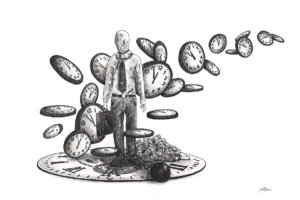

Overthinking is something almost everyone experiences at certain points in life. We replay certain moments, get stuck inside a past event, and circle the same ground for hours on the edge of an important decision. People who go through this loop often eventually start describing themselves as an “overthinker.” So what does overthinking really mean, is it truly an illness, and is it possible to break out of the loop?
This article treats overthinking not as a buzzword but through one of psychology’s most established findings. The key insight is this: not all intense thinking is bad. What harms you is spinning the same negative thought while judging yourself; what helps you is thinking that genuinely aims to solve a problem. Telling the two apart is the key to breaking the loop.
TL;DR
- Overthinking is not one single thing. In psychology, the clearest distinction is between “brooding” (dwelling in a vicious circle) and the more constructive “reflection” (analytical thinking).
- This distinction comes from Susan Nolen-Hoeksema’s Response Styles Theory. Research shows that rumination, meaning turning a negative thought over and over, intensifies and prolongs negative mood and also impairs problem solving.
- The most insidious part of overthinking is that it feels useful: it seems as if you are solving the problem by thinking about it, when most of the time it only feeds the anxiety.
- The way out of the loop is not more willpower but a system: noticing which mode you are in, setting yourself a stopping rule, and turning thinking into action or into a deliberate letting go.
- Decide like a CEO: after evaluating enough, choose and close the loop. Learn like a student too: treat every decision as a lesson for thinking more clearly next time.
What Is Overthinking? (Illness or Habit?)
Literally, overthinking means thinking about a subject more and longer than necessary. But the word “illness” can be misleading. Overthinking is not a medical diagnosis in itself; it is more of a mental habit pattern that can feed conditions such as anxiety and depression. The good news is that habits can be changed.
The pioneering work of psychologist Susan Nolen-Hoeksema offers the most solid framework for understanding this pattern. Her Response Styles Theory shows that the way we respond to a negative emotion determines how long that emotion lasts. Turning the same distress over in your head (rumination) prolongs and deepens it; shifting your attention elsewhere or moving toward solving the problem eases it. More importantly, later research revealed that rumination itself splits into two: judgmental, vicious “brooding” and analytical, more constructive “reflection.”
The Three Modes of Overthinking (CEOtudent editorial framework)
Not every thought spinning in your mind belongs in the same category. The table below separates the vague feeling of “I’m thinking too much” into three distinct modes. Naming which mode you are in is often the first and most powerful step toward breaking the loop. This is an editorial framework grounded in psychology research.
| Mode | How it feels | What it actually does | The right move |
|---|---|---|---|
| Brooding | “Why does this always happen to me, if only things had gone differently” | Feeds and prolongs the negative emotion; produces no solution | Notice and cut it; turn attention to action or a physical activity |
| Reflection | “What exactly happened here and what can I learn from it” | Examines the experience without judgment; can produce insight and learning | Give it a limited window, then commit to a conclusion |
| Productive worry (problem-solving) | “What can I do about this risk” | Useful when it turns into a concrete action | Turn it into a step; if there is no step, let the worry go |
The key point in the table is this: brooding never helps and should be cut the moment you notice it. Reflection and problem-solving can be useful, but only when tied to a stopping rule. Open-ended thinking turns even the most constructive thought into brooding.
Is Overthinking Treatable? The Way Out of the Loop
The word “treatment” suggests a one-off intervention that ends in a single step; but dealing with overthinking is more like a skill you develop. If there is intense anxiety or depression that impairs your functioning, seeing a mental health professional is the right move. For the everyday habit of overthinking, a few principles are decisive.
First, name the mode. When your mind starts spinning, ask yourself: is this brooding, or am I actually solving something? That question alone often slows the loop. Second, set a stopping rule. Decide in advance how much time you will give a decision; when the time is up, pick the best option you have and close the subject. Third, turn thinking into action. Productive worry is valuable if it can turn into a concrete step; if it cannot, that worry is just anxiety and should be released.
Here the CEO-and-student pairing does exactly its job. A CEO does not analyze forever; after evaluating enough, they make the decision and close the loop, because they know the real cost is being unable to decide. A student, meanwhile, treats every decision, whatever its outcome, as a lesson for thinking more clearly next time. The antidote to overthinking is not more thinking but better-structured thinking.
FAQ
Is overthinking an illness?
It is not a medical diagnosis on its own. Overthinking is a mental habit pattern that can feed conditions such as anxiety and depression. That is why it can be changed; however, if it becomes intense and starts to make life difficult, you should get support from a professional.
What is the difference between brooding and reflection?
Brooding is turning a negative thought over and over while judging yourself, and it produces no solution. Reflection is examining the experience without judgment and trying to learn from it. Research shows that brooding strongly feeds negative emotion, while reflection can be more constructive.
Why does overthinking feel useful?
Because it creates the illusion that you are solving the problem by thinking about it. In reality, most of the time it only feeds the anxiety and impairs problem solving. The key question is whether your thinking turns into a concrete action.
How do I stop the overthinking loop?
Three steps help: name the mode you are in, set a stopping rule for how much time you will give a decision, and turn thinking either into an action or into a deliberate letting go. The goal is not to forbid thinking, but to draw a boundary around it.
What should I do to avoid overthinking when making a decision?
Act like a CEO: set a stopping rule before you start evaluating, and choose when the time is up. Not searching for the best among endless options, but choosing a good option that clears the bar on time, is the strongest antidote to overthinking.
Sources
- Susan Nolen-Hoeksema, Response Styles Theory (1991), the pioneering work on how rumination intensifies and prolongs negative mood and impairs problem solving.
- Susan Nolen-Hoeksema, Blair E. Wisco and Sonja Lyubomirsky, “Rethinking Rumination” (2008), separating rumination into its brooding and reflection components.
- American Psychological Association (APA), general references on anxiety, rumination and cognitive behavioral approaches.
- World Health Organization (WHO), general frameworks on mental health and anxiety disorders.
This content was compiled with the support of AI following in-depth research, then written and prepared for publication by the CEOtudent editorial team.
This post is also available in: